Carry-On vs Personal Item: A Traveler’s Guide

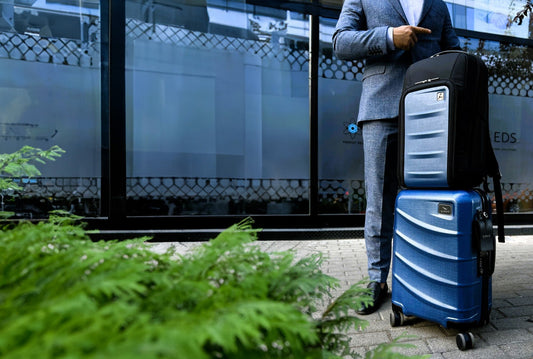
I remember hauling a bright red suitcase and a small backpack as I rushed to the gate. That backpack was my “personal item,” and the red roller was my carry-on. It felt a bit like performing a balancing act with luggage, but it made me wonder if the words the airline used to classify my stuff had any meaning. I soon realized that carry-on and personal items aren’t just fancy terms; they decide what I can bring on board. Over the years of traveling, I’ve learned that a carry-on is usually the larger bag that goes in the overhead bin, while a personal item is a smaller bag under the seat in front of you. Think of the carry-on as your trusty suitcase and the personal item as your trusty daypack or tote.

The Basics: What’s the Difference?
In plain terms, a personal item is smaller. It might be a purse, laptop bag, briefcase, or small backpack, and it fits completely under the seat. A carry-on is bigger – often a wheeled bag or larger duffel that you stow above your seat. For example, Delta says each passenger can bring one carry-on bag and one personal item free of charge. Carriers like Delta envision the carry-on as a roll-aboard (up to about 22×14×9 inches, including wheels), and the personal item as something like a handbag or laptop bag. In practice, this means you could pack your clothes in the larger carry-on (overhead) and keep your wallet, book, or tablet in the smaller bag under your seat.
I often tell fellow travelers: treat your personal item as your go-with-you bag (it stays by your feet) and your carry-on as your stored-away bag (it lives overhead). Airlines enforce this strictly. For example, Delta’s policy calls a personal item “a purse, laptop bag, or item of similar size that will fit underneath the seat”. United Airlines has a similar rule: one carry-on and one personal item allowed on most flights. The overhead bins are the “closet” for your carry-on, and everything else (including your personal item) is under your seat.
Size Limits: Carry-On vs Personal
The exact size limit depends on the airline, but here are typical dimensions:
-
Carry-on size: For most US carriers, carry-on bags are typically limited to dimensions of around 22″ × 14″ × 9″ (56 × 35 × 23 cm). For example, Delta’s site says a carry-on must have a combined length, width, and height of no more than 45 linear inches (about 114 cm). United similarly limits carry-ons to 9″×14″×22″. These measurements include wheels and handles. I always check my bag with a ruler at home to be sure!
-
Personal item size: This is smaller. United, for instance, specifies that personal items can be up to 9″×10″×17″ (22×25×43 cm). Spirit’s personal item size limit is roughly 18″×14″×8″ (45×35×20 cm), and Frontier’s is 14″×18″×8″. In simple terms, if it doesn’t fit under the seat in front of you, it’s not a personal item.
Airlines often give examples of allowed personal items: things like a purse, tote, small backpack, or camera bag. If your bag is “too large” (say a mid-sized roller bag) and exceeds that small limit, it would count as a carry-on instead and might not fit under your seat. When boarding, flight attendants might check or gate-check oversized personal items.
I once saw a family learn this the hard way. The dad had a large bag he thought was a “personal item,” and it wouldn’t go under the seat. He ended up putting it on top of a friend’s carry-on in the bin! Now I always measure carefully.
Carry-On vs Checked Baggage
One common question is how checked bags differ from carry-ons and personal items. Checked baggage is left in the plane’s cargo hold and typically can be much larger. Most airlines allow checked bags up to 62 linear inches (the sum of length+width+height) and around 50 pounds (23 kg) without extra oversize or overweight fees. For example, Delta notes a checked bag should not exceed 62 inches total and around 50 pounds for standard fares. Frontier similarly limits checked bags to 62 inches and 40 pounds.
In contrast, carry-on and personal items come on board with you and have much smaller limits and usually travel free. Checked bags often cost extra (especially on budget flights), while carry-ons and personal items are often included in your fare. If you compare them: checked bag = largest, stows under the plane; carry-on = medium, overhead bin; personal item = small, under your seat.
Airline-by-Airline Rules

Different airlines have slightly different rules and fees. Here’s what I’ve found:
Delta Air Lines
On Delta, every passenger (coach or basic economy) can bring one carry-on bag and one personal item on board for free. The carry-on must fit the overhead bin (no more than 22×14×9 inches including wheels). The personal item (like a purse or laptop bag) simply must fit under the seat in front. Delta even notes typical examples: “1 purse, briefcase, small backpack, belt bag, [etc.]” fits.
Delta’s rules are pretty generous – even in Basic Economy, you still get both items. (Be aware, however, that on small regional jets (fewer than 50 seats) only personal items are allowed because overhead bins aren’t available.) When I travel with Delta, I always bring both: for example, a rolling tote upstairs and a backpack as my personal item. The size check is usually easy: their counters have a bin for measuring. If a bag is too large, staff might gate-check it for free.
Spirit Airlines
Spirit is a budget airline where only the personal item is free by default. Every Spirit fare includes one personal item (up to 18×14×8 inches) – think a small backpack or purse that fits under the seat. Examples they give are “umbrella, assistive devices, outer garments,” beyond your one small bag.
Carry-on bags on Spirit (the bigger 22×18×10-inch bags) are not included with the cheapest fare (called “Value”). You have to pay extra for a carry-on (unless you buy a higher fare bundle). If you do pay, then Spirit’s Premium or First fares include one carry-on in addition to your personal item.
I once flew Spirit with just a 10kg backpack (under the seat) to avoid the carry-on fee. On the flight back, I splurged for a checked bag because my cheap fare would have charged a lot at the gate. The lesson: know Spirit’s structure. But size-wise, the rules are clear: personal items up to 18×14×8 inches, carry-ons up to 22×18×10 if you’ve paid for them. Anything larger at boarding gets gate-checked (with a fee).
Frontier Airlines
Frontier’s rules are similar to Spirit’s. Each passenger is allowed one personal item for free. Frontier’s personal item limit is 14×18×8 inches (including handles and wheels). They list examples like “purses, totes, diaper bags, small backpacks” in this category. Frontier is known to be strict about this size – at boarding, they will literally check your bag against a sizer to make sure it fits.
For a carry-on, Frontier allows larger bags (think small suitcases), but again, it’s only free if you purchase it with your ticket or add it later. Frontier’s carry-on limit is 24×16×10 inches and under 35 lbs. Without paying, you only get the tiny personal item. I’ve heard many travelers say Frontier is aggressive about checking oversized personal items at the gate (sometimes charging $60 or more), so it’s best to pack just the right size to avoid surprises.
In short, for Frontier: personal item = 14×18×8″ included; carry-on = 24×16×10″ if you’ve added it. Checked bags (62 linear inches, 40 lbs) are extra.
United Airlines
United’s normal economy passengers can bring one carry-on and one personal item, much like Delta. The carry-on must be no larger than 9″×14″×22″ (height×width×length). Personal items on United are capped at 9″×10″×17″, which is fairly small (purses and slim laptop bags usually fit). Weight isn’t a specific limit for carry-ons or personal items on United; you just need to be able to lift the carry-on into the bin yourself.
There is one big caveat on United: Basic Economy tickets. In Basic Economy (except on certain international routes or for certain members), United allows only one personal item and no carry-on bag. In other words, if you have a cheap Basic Economy ticket, you might have to check your roll-aboard unless you buy a carry-on upgrade. I’ve seen passengers get caught by this—so I always double-check my fare rules. For standard (non-basic) tickets, United’s approach is straightforward: one of each.
Ryanair
Ryanair (a major European budget carrier) is a bit different. All fares include exactly one small personal bag free of charge. That is strictly a small handbag or laptop bag up to 40×30×20 cm (about 16×12×8 inches) which must fit under the seat. If you want to bring a larger cabin bag (the common 55×40×20 cm wheeled bag), you must pay for “Priority & 2 Cabin Bags” or have a higher fare. With Priority, you get to carry that bigger bag (up to 10 kg) in addition to your small personal item.
In practice, it means: without Priority, Ryanair is more restrictive than US airlines – your free bag is really tiny. With Priority, you can have a standard carry-on (55×40×20 cm) and a little personal bag. If either bag doesn’t meet the allowance at boarding, Ryanair will gate-check it (for a fee). I remember traveling Ryanair with just a light daypack (so no surprise fees), whereas my friend with the wheeled cabin bag had to add Priority. The bottom line: Ryanair’s “personal item” is smaller than what US airlines allow.

Key Takeaways
-
Free allowance: Most US airlines give you 1 personal item + 1 carry-on for free. Budget airlines (Spirit, Frontier) only include the personal item by default.
-
Where they go: Personal items stay under the seat; carry-ons go in the overhead bin.
-
Size matters: Measure before you pack. Typical carry-on limits are ~22×14×9 in. Typical personal item limits are smaller: e.g. United’s 9×10×17 in or Spirit’s 18×14×8 in.
-
Checked baggage: Much larger (up to ~62 linear inches, ~50 lb) and usually costs extra.
-
Airline quirks: Spirit and Frontier treat the carry-on as an add-on unless you pay. United’s Basic Economy usually means only the personal item is included. Ryanair, without priority, only gives a very small personal bag.
Traveling with the right knowledge feels a lot like packing a puzzle. Once you know the rules, you avoid the panic at the gate when a bag is too big to fly. I keep a little tape measure in my carry-on now, and I double-check each airline’s site (like Delta or United) before I pack. With a bit of prep, you can breeze on board – with your baggage intact. Safe travels!